
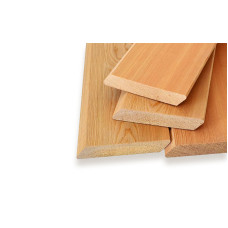
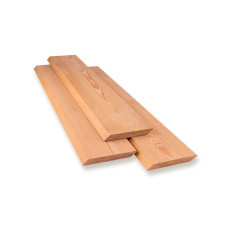
Rhombus Cladding — Price List:
| Dimensions, mm | Length, m | Material/Grade | Price, UAH/m² |
|---|---|---|---|
| 20×130 | 3.0; 4.5 | pine/AB | 570 |
| 20×140 | 3.0; 4.0 | pine/AB | 570 |
| 20×130 | 2.0; 2.5; 3.0; 4.0; 5.0; 6.0 | spruce/AB | 665 |
| 20×150 | 4.0; 5.0; 6.0 | spruce/AB | 665 |
| 20×125 | 3.0; 4.0 | larch/AB | 1 235 |
* Prices are shown excluding VAT. VAT — 20%.
Wooden planken is a modern planed timber cladding board used for both exterior and interior finishing. It is suitable for cladding private houses and commercial buildings, as well as for terraces, gazebos, fences, decorative walls and other architectural elements. At FOREEST, you can buy wooden planken in Ukraine made from pine, spruce and larch in various sizes and lengths.
Wooden planken is valued for its natural appearance, practicality and suitability for modern ventilated façades. Properly dried and processed timber provides stable geometry, while an appropriate protective coating helps improve resistance to moisture, UV radiation and weather exposure.
Advantages of wooden planken
Planken is manufactured from dried timber that undergoes precision machining and profiling. Accurate board geometry simplifies installation and helps create a neat, uniform façade or interior finish.
- natural and environmentally friendly material;
- attractive natural wood texture;
- suitable for exterior and interior applications;
- can be installed with visible or concealed fixings;
- suitable for ventilated façade systems;
- wide choice of protective and decorative finishes;
- individual damaged boards can be replaced without dismantling the entire façade;
- long service life when properly treated and installed;
- combines well with metal, stone, glass and other façade materials.
Types of planken
Depending on the profile, the most common types are straight planken and bevelled planken (rhombus profile). The choice depends on the façade design, installation method and desired appearance.
Straight planken has straight side edges. The boards are installed with a small expansion gap that provides ventilation and allows for natural dimensional changes in the timber. This profile creates clean, straight lines and is particularly suitable for modern façades.
Bevelled planken (rhombus profile) features angled side edges. The shape of the profile visually covers the gap between adjacent boards, creating a distinctive and uniform appearance. Bevelled planken is widely used for façades, fences, gazebos and decorative cladding.
Pine, spruce and larch planken
The characteristics and price of wooden planken depend on the timber species, grade, dimensions, length and profile. The FOREEST range includes softwood options suitable for different applications and budgets.
Pine planken is a practical and cost-effective option for façade and decorative cladding. Pine has an attractive natural grain and can be easily painted, stained or treated with protective wood oils.
Spruce planken has a naturally light colour and distinctive wood grain. It can be used for façades, decorative cladding, fences and various architectural structures.
Larch planken has a higher density and good natural durability. It is frequently selected for exterior applications and structures exposed to changing moisture conditions.
Where is wooden planken used?
Wooden planken is a versatile finishing material. It can be used as the main cladding material or as a decorative element combined with other building and façade materials.
- house façade cladding;
- gable and eaves finishing;
- decorative wall and interior cladding;
- gazebos and terraces;
- wooden fences;
- commercial interior and exterior finishing;
- decorative architectural structures.
How to protect wooden planken?
For exterior applications, timber should be protected with a suitable wood finish. Façade oils, stains, paints and other wood protection products can be used. Proper treatment helps protect the surface against moisture, UV radiation and dirt while also allowing you to achieve the desired colour and appearance.
Particular attention should be paid to board ends and freshly cut surfaces. The type of protective finish and maintenance intervals should be selected according to the timber species, exposure conditions and the coating manufacturer's recommendations.
Planken installation
Planken installation is carried out on a prepared substructure while maintaining the required gaps between the boards. For façade applications, the construction should provide adequate ventilation behind the timber cladding and allow moisture to drain away.
Planken can be installed using visible or concealed fixing systems. With visible fixing, the boards are secured through the face using suitable fasteners. Concealed installation uses special fixing systems that keep the fasteners virtually invisible on the finished façade.
The appropriate fixing method depends on the planken profile, timber species, supporting structure and operating conditions. Correct installation helps maintain the geometry of the cladding and contributes to a long service life.
Buy wooden planken in Ukraine
At FOREEST, you can buy wooden planken in Ukraine for façades, fences, terraces and interior finishing. Our range includes straight and bevelled planken made from pine, spruce and larch in various dimensions and lengths. Current dimensions and planken prices per m² are listed in the price table on this page.
We supply private customers, construction companies, contractors and wholesale buyers. Our team can help you select the appropriate type of planken and calculate the required quantity. Delivery is available in Kyiv, the Kyiv region and throughout Ukraine.
-
✍️Which planken is best for façade cladding?
-
❓What is the difference between straight planken and rhombus planken?
-
❗Should planken be treated before installation?
-
⭐How is planken installed?
-
✅Where can planken be used?
-
❓What determines the price of planken?