Undoubtedly, installing a wooden floor is the right decision. But for those who have never encountered this, many questions arise. Including the question of how thick the floorboard should be. The answer will not be clear, but it depends on the wood, the planned load, the laying method, the type of lumber.
Thickness of floorboards of different wood
Wood of different species has different characteristics of density, strength and wear resistance. Hard grades are more durable and resistant to abrasion.
- The first places in terms of hardness are occupied by overseas trees: Jacoba, Sucupira, Che, Eben, Amazonian Yarra and others. Their Brinell hardness index is from 5 to 8.
- Among the traditional species used to make floorboards, ash (4.0), beech (3.8), oak (3.7) are considered hard.
- And among conifers, larch has the hardest wood (2.6).
- Pine is a little denser and harder than spruce. It has more resin channels, which makes it moisture-resistant and more wear-resistant.

Strength depends on:
- cut;
- conditions in which the tree grew;
- quality of lumber.
A board sawn radially has a smaller width between the annual layers and this makes it stronger than a tangential one. Although such lumber is more expensive, since when cutting a log, its yield is about 15%. The location of the growth rings is also affected by the growth rate of the tree. The more layers, the greater the strength.
The presence of knots reduces strength. The highest grade has no knots. It is stronger than grade “A”, where the presence of live knots is allowed, and even more so than grade “B” with dead and falling out knots. All this must be taken into account when choosing the thickness of the floorboard.
Laying method and thickness
It is especially important to choose the correct thickness of the floorboard when laying it on joists. An error in choosing the thickness can lead to the floorboard creaking or breaking under the weight. And thick lumber is harder to work with and more expensive.
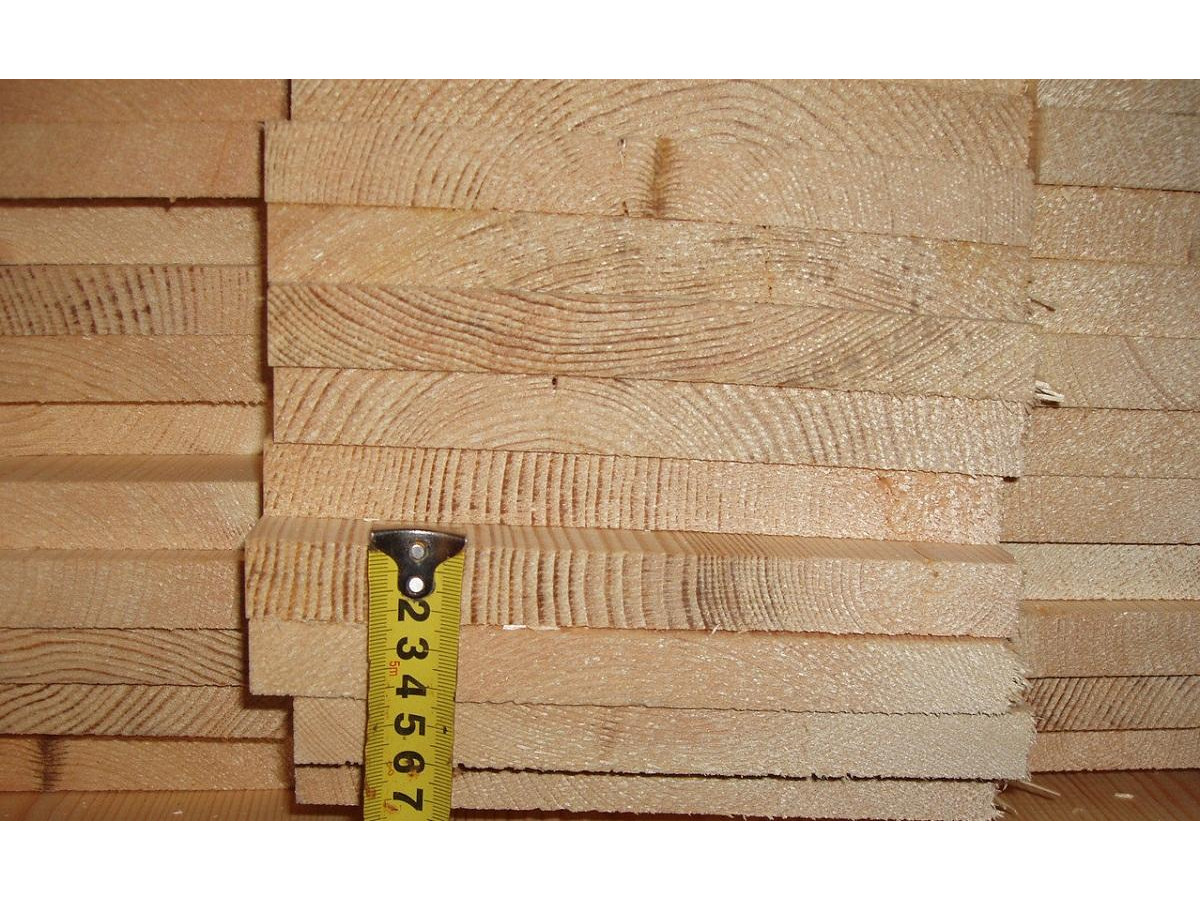
The distance between the joists determines the thickness of the floorboard. Many people make it 0.4 - 0.6 m. In this case, the thickness of the floorboard is 30-36 cm. If the logs are installed wider, you should take thicker lumber. Adjustments must be made for the expected load. In walkways or industrial premises, thicker floorboards are used or logs are installed more often.
The type of board also matters.
- When using edged board the load is not distributed to adjacent ones.
- It happens completely differently with tongue and groove. Through the nearby boards, the pressure is distributed over the entire floor, which allows the use of materials of less thickness.
When the board is laid on concrete, plywood or on an existing floor, a thickness of 20-28 cm is sufficient. The correct thickness will allow you to create a reliable floor and not pay extra money.