
The beauty and reliability of the floor depends not only on the type of wood, the parameters of the board, but also on the quality of its installation. How to attach floorboard, if there are many ways? Let's consider the most common and proven ones.
How to attach floorboards to joists
This is the most common installation method, as it is reliable and relatively simple. It is not used if the height of the ceilings of the room is small, and due to the thickness of the joists and floorboards it can be reduced to critical.
- The distance between the joists correlates with the thickness of the board and its strength. The thicker and stronger the board, the wider the distance. As a rule, no more than 90 cm.
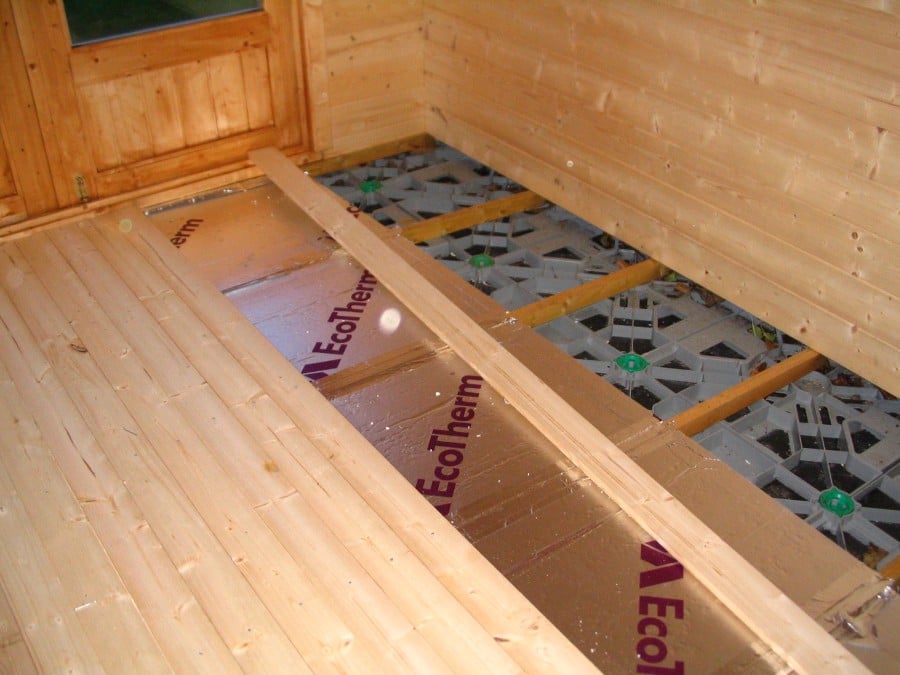
- Before installation, logs soaked in antiseptic are leveled. On the ground floor or in damp rooms, logs are installed on waterproofing (usually roofing felt), and thermal insulation is laid between them. For fastening, nails or screws are used, the length of which should be twice the thickness of the board.
- The first row is attached at a distance of 2-4 mm from the wall. The fastening extends perpendicularly along the edge, so that nails or screws can be hidden by the plinth.
- Nails are driven in at a slight angle, alternately in opposite directions and deep, so that they can be subsequently covered with decorative putty.
- It is safer and easier to fasten the board with self-tapping screws. For soft wood species (pine, spruce, fir) use wide caps. For hard wood (oak, ash, larch), the head should be small and the screw should have a self-drilling drill. They are twisted into a tongue and groove board at an angle of 45 degrees into a tenon or into the lower part of a groove. The cap should not protrude so as not to interfere with the tight tongue-and-groove connection. To prevent the fasteners from splitting the board, you must first make a hole with a drill.
- To avoid gaps, each board is firmly pressed against the already fixed one before fastening. This is done using stops, wedges, chisels or special jacks. The last board is pressed against the wall with wedges and screwed with screws along the edge, similar to the first.
How to attach floorboards to concrete
This can be done in the following ways: fastening to joists, to plywood, to glue.
- But first of all, it is necessary to create a waterproofing between the board and the concrete. For this purpose, waterproofing films or mastic are used. The concrete must be strong and level. When installing on logs, timber is used.
- If the floor is mounted on plywood, it must be moisture resistant and 18 mm or more thick. You can cut it into strips 35-55 cm wide. Attached to concrete with dowels.
- The quality of installation with glue depends on the strength of the glue itself. This is especially important when the length of the board is more than 50 cm. With this method, the boards are additionally secured with self-tapping screws.

How to attach floorboards to an existing or subfloor.
- First of all, you need to check its strength, fix it and sand it if necessary.
- Then attach the boards using one of the methods described above.
- In this case, the boards are mounted perpendicular to the existing ones.
- Correct and high-quality fasteners will ensure the beauty and durability of the floor.