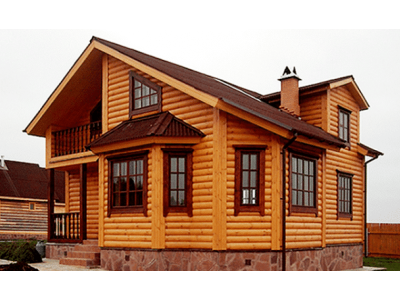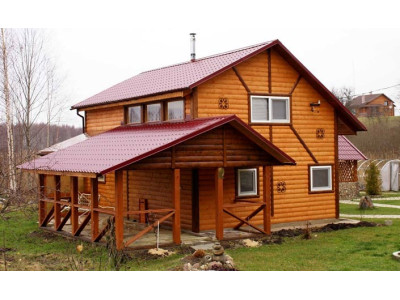
A block house can be used to decorate any building, which will give it the appearance of a log house made of solid wood. Durable, aesthetic, natural material is in great demand for a reason. The reliability of the cladding and its appearance largely depends on the quality of the fasteners, which begins with the installation of the sheathing. It must ensure fastening strength and strict verticality of the block house that is mounted on it. How to make sheathing for a block house correctly?
Lathing for a block house made of wood
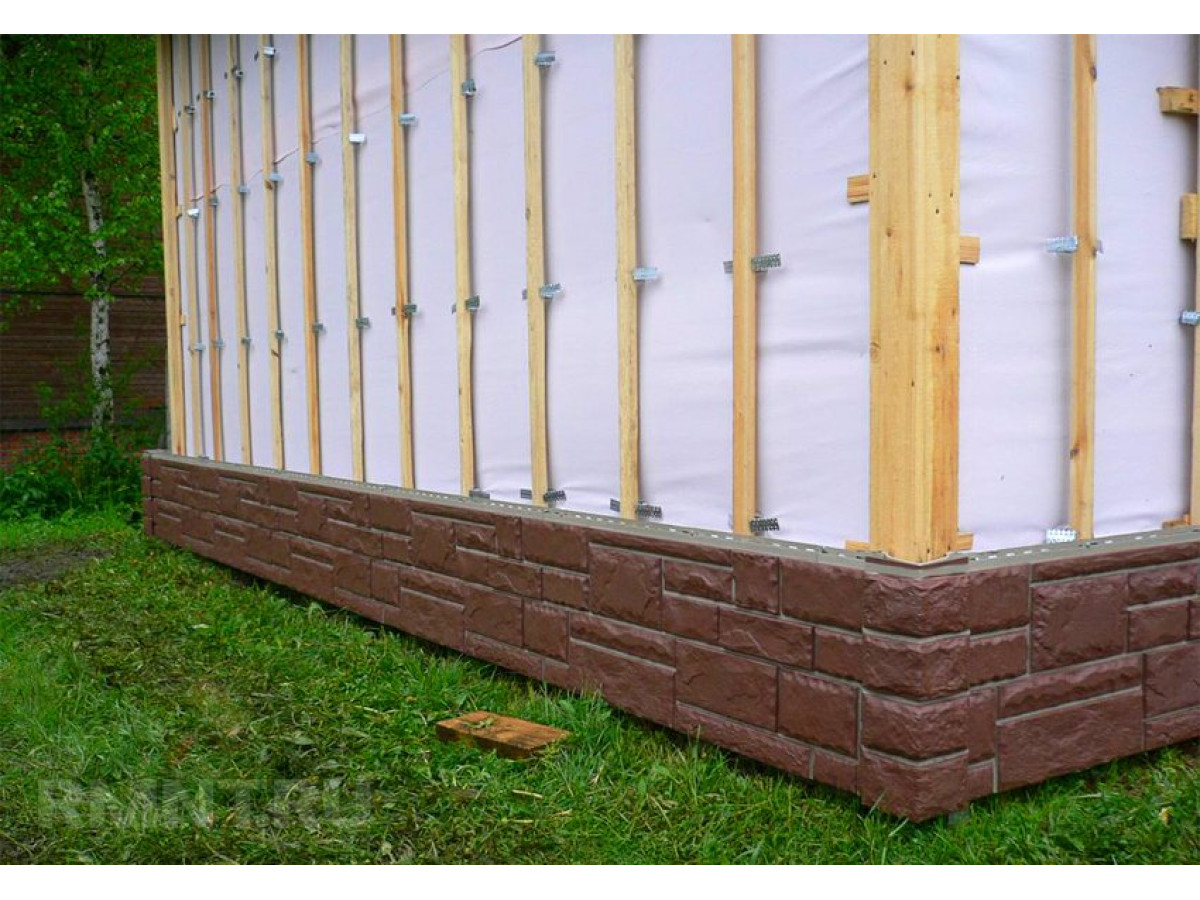
- Wooden sheathing for external finishing is made from dried timber with a cross-section of at least 4x5 cm.
- At the joints, the beam must be wider so that two panels can be attached to it.
- The sheathing is attached to the wall with self-tapping screws or nails level or plumb in increments of 40 - 45 cm.
- To achieve a vertical position, use wooden pads (pieces of timber or boards).
- Before attaching the sheathing, the walls are freed from dirt and covered with a layer of waterproofing.
- Before installation, the timber must be treated with impregnations against mold fungi and pests.
- Initially, the bars are installed along the edges of the wall.
- A thread is stretched between them, along which the others are attached.
- The distance between the beams is selected depending on the width of the insulation that is used, but it should not exceed 65 cm.
- Then a vapor barrier is stapled to the insulation and sheathing, and a counter-lattice is placed on the beams.
- It is made from small slats with a cross-section of 3x4 or 3x5 cm. This is necessary to create a ventilation gap between the block house and the insulation.
- If this is not done, moisture may accumulate and lead to mold.
- The sheathing is made vertical, since the block house is mounted horizontally. But it happens that they make a horizontal lathing for insulation, cover it with a vapor barrier, and then vertically fill the counter batten slats perpendicularly.
Lathing for a block house made of metal
A metal or vinyl block house is usually mounted on it. It performs the same tasks as a wooden one, but lasts longer, although it is more expensive.
- It is made of profiled galvanized metal or aluminum with a thickness of 0.45 - 0.55 cm.
- SD-60 and UD-28 profiles are used. They are mounted either on a wooden sheathing with insulation, covered with a vapor barrier, or on metal hangers or brackets, which is more reliable.
- In the second case, hangers or brackets are installed in advance, and the insulation is attached to the wall with façade dowels for insulation (“parachutes”) along with a vapor barrier.
- The fasteners must protrude enough to allow the sheathing profiles to be screwed to them.
- The first racks of the sheathing are mounted along the edges of the wall with self-tapping screws on the upper hangers.
- Then the level is fixed strictly vertically at the bottom.
- Next they are attached to all the hangers in the middle.
- When the outer profiles are installed, the remaining profiles are attached with a thread stretched between them in increments of 35-50 cm.
- Around windows and doorways, sheathing is installed around the perimeter.
- Profiles can be connected along the length using a special LED connector.
When installing a vinyl block house from some manufacturers, it is necessary to attach a special mounting profile to the sheathing, which comes complete with the panels.
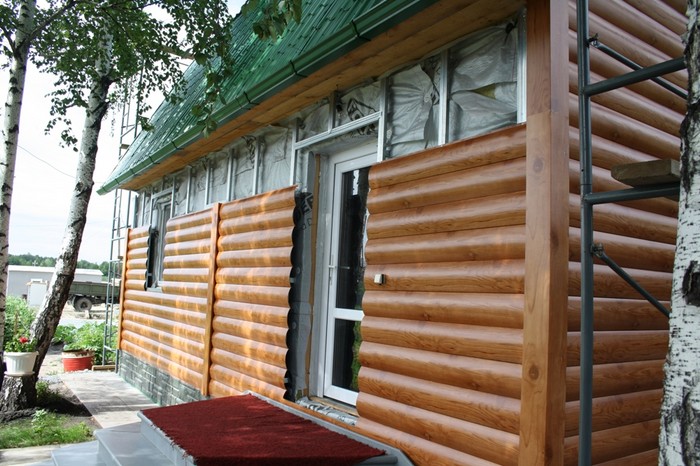
Regardless of the material from which the sheathing for a block house is made, it must effectively fulfill its main task: to ensure long-term and aesthetically attractive functioning of the cladding.